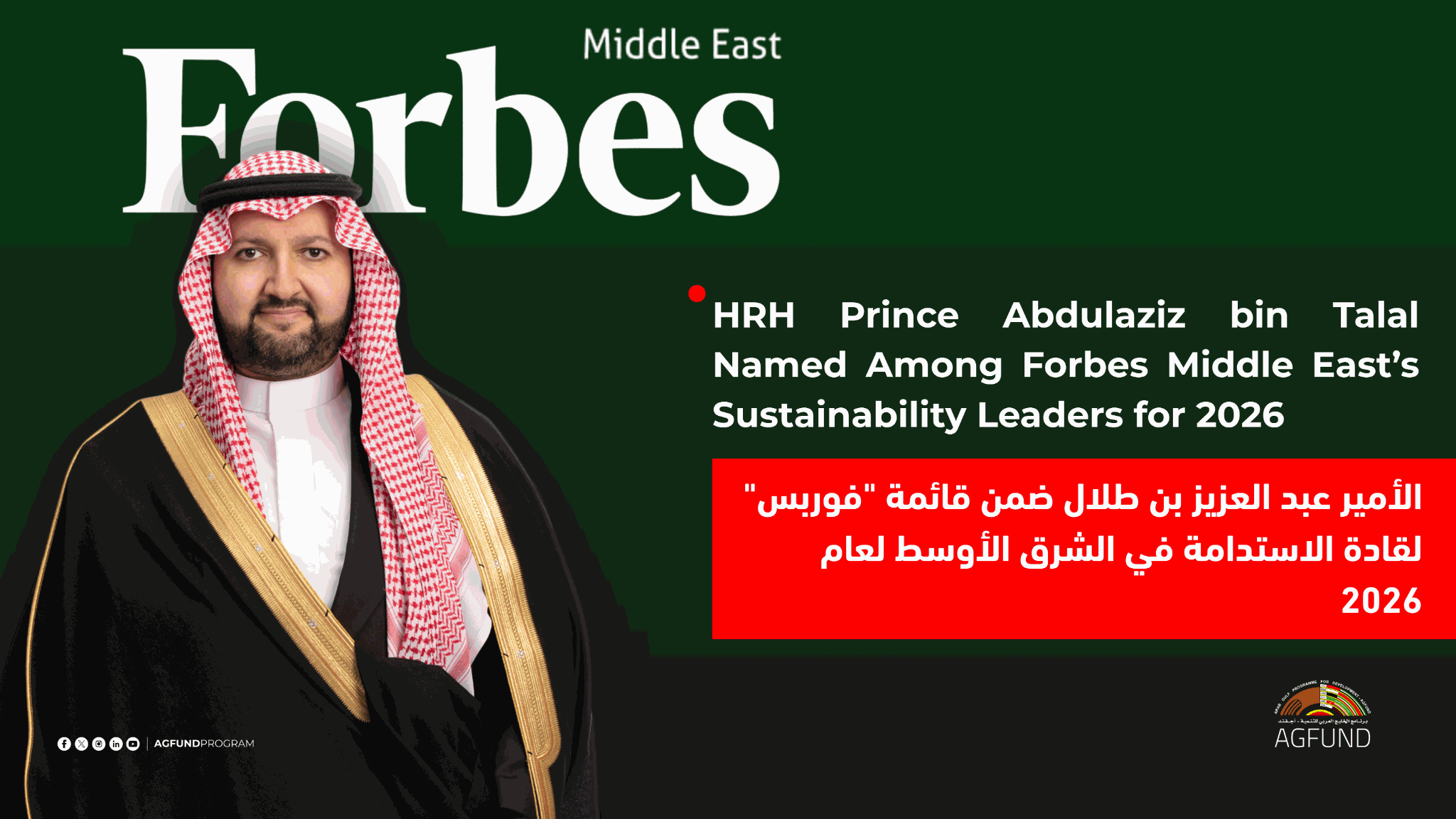
Forbes Middle East has included His Royal Highness Prince Abdulaziz bin Talal bin Abdulaziz Al Saud—President of the Arab Gulf Program for Development (AGFUND)—in its 2026 list of Sustainability Leaders in the Middle East. This recognition honors his role in spearheading the program’s development efforts and advancing initiatives that contribute to sustainable development and an improved quality of life.
Prince Abdulaziz bin Talal has served as President of AGFUND since 2020, continuing the legacy of the organization, which was established in 1980 and is headquartered in the Kingdom of Saudi Arabia. AGFUND works to support development initiatives in collaboration with partners and institutions dedicated to development worldwide.
In addition to his role as President of the AGFUND Board of Directors, Prince Abdulaziz chairs the program’s Supreme Investment Committee and the Prince Talal International Prize for Human Development Committee. He also serves as Chair of the Board of Trustees for the Arab Open University, the Center of Arab Women for Training and Research (CAWTAR), and the Arab Council for Childhood and Development. Furthermore, he chairs the Board of Trustees of the "Ahyaaha"
(Prince Abdulaziz bin Talal and Sora bint Saud for Human Development) Foundation. In 2020, he oversaw the establishment of the Prince Talal bin Abdulaziz Endowment system, which operates through various development-focused institutions and non-profit entities. These initiatives are dedicated to empowering the maternal and child care sector in the Kingdom of Saudi Arabia, having reached approximately 50,000 mothers and children within the Kingdom
to date. This role extends to continuing the developmental legacy of the late Prince Talal bin Abdulaziz—may he rest in peace—which was rooted in empowering individuals and upholding their dignity. This legacy is carried forward through institutions and partnerships designed to create a sustainable impact on the lives of communities; Prince Abdulaziz bin Talal continues this approach through his responsibilities within various developmental, charitable, and endowment-based organizations.
Since its inception, AGFUND has supported 1,818 developmental projects across 172 countries, in collaboration with over 500 development partners. These efforts are aimed at broadening the scope of comprehensive development and enhancing access to essential services and resources for the targeted groups and communities. During its most recent semi-annual meeting, the Board of Directors approved the program’s strategy through 2030 and authorized funding for 15 new developmental projects.
The program focuses on areas aligned with sustainable development priorities—including financial inclusion, open education, technical empowerment, social development, water and food security, and health. This reflects a commitment to supporting developmental solutions that address societal needs, expand access to basic services, and strengthen the capacity of communities to achieve more sustainable development.
Furthermore, AGFUND supports initiatives aimed at raising awareness about climate change and enhancing the ability of communities to adapt to its impacts. An example of this is the "Green in Arabic" (Green Bil-Arabi) platform—launched in partnership with the Arab Network for Non-Governmental Organizations—which focuses on raising awareness of climate change issues and fostering environmental knowledge in the Arabic language. The program participated in the sixteenth session of the Conference of the Parties (COP16) to the United Nations Convention to Combat Desertification, hosted in Riyadh. During the event, a global food security initiative was announced, aimed at supporting smallholder farmers and enhancing the sustainability of their contributions to agricultural production. The initiative has brought together over 30 entities—including governments, international organizations, private sector institutions, and research centers—to work toward mitigating the impacts of drought, desertification, and the risks posed by climate change to the agricultural sector.
The inclusion of Prince Abdulaziz bin Talal on the Forbes list of sustainability leaders in the Middle East for 2026 reflects a growing focus on the role that development institutions play in fostering sustainability. This is achieved through initiatives and programs that bridge social impact with economic development, while supporting the creation of more inclusive communities capable of confronting future challenges.